The Ironies of Automation, Forty Years Later
In 1983, a cognitive psychologist wrote five pages about why automating factories makes operators worse at their jobs. In 2026, every company deploying agentic AI is learning the same lesson for the first time.
The Paper
In 1983, Lisanne Bainbridge published a five-page paper in Automatica titled "Ironies of Automation." It was about process control in factories and power plants. By November 2016 it had attracted roughly 1,800 citations 9Strauch, B. (2017). "Ironies of Automation: Still Unresolved After All These Years." IEEE Transactions on Human-Machine Systems, 48(5), 419-433., and the rate was accelerating. It is now one of the most cited papers in the history of human factors engineering.
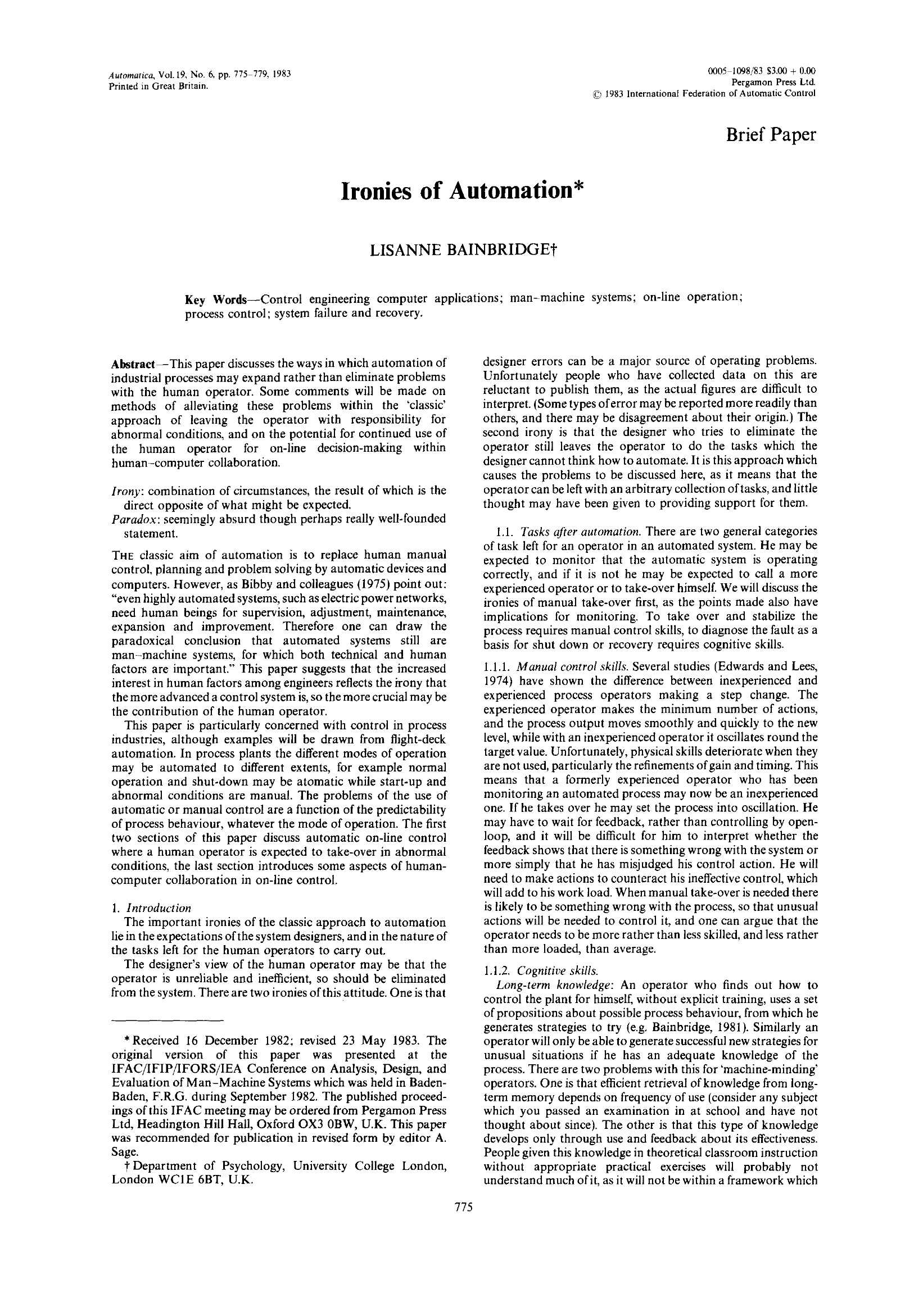
The paper's argument is not complicated. It can be stated in a single sentence: the designer's view of the human operator is that the operator is unreliable and inefficient, so should be eliminated from the system, but the designer who tries to eliminate the operator still leaves the operator to do the tasks which the designer cannot think how to automate.
That sentence contains two ironies. First: the tasks left to the human are, by definition, the ones the designer could not solve. They are the hardest tasks in the system, not the easiest. Second: the human who must perform these tasks has been removed from active practice by the very automation that now demands their expertise.
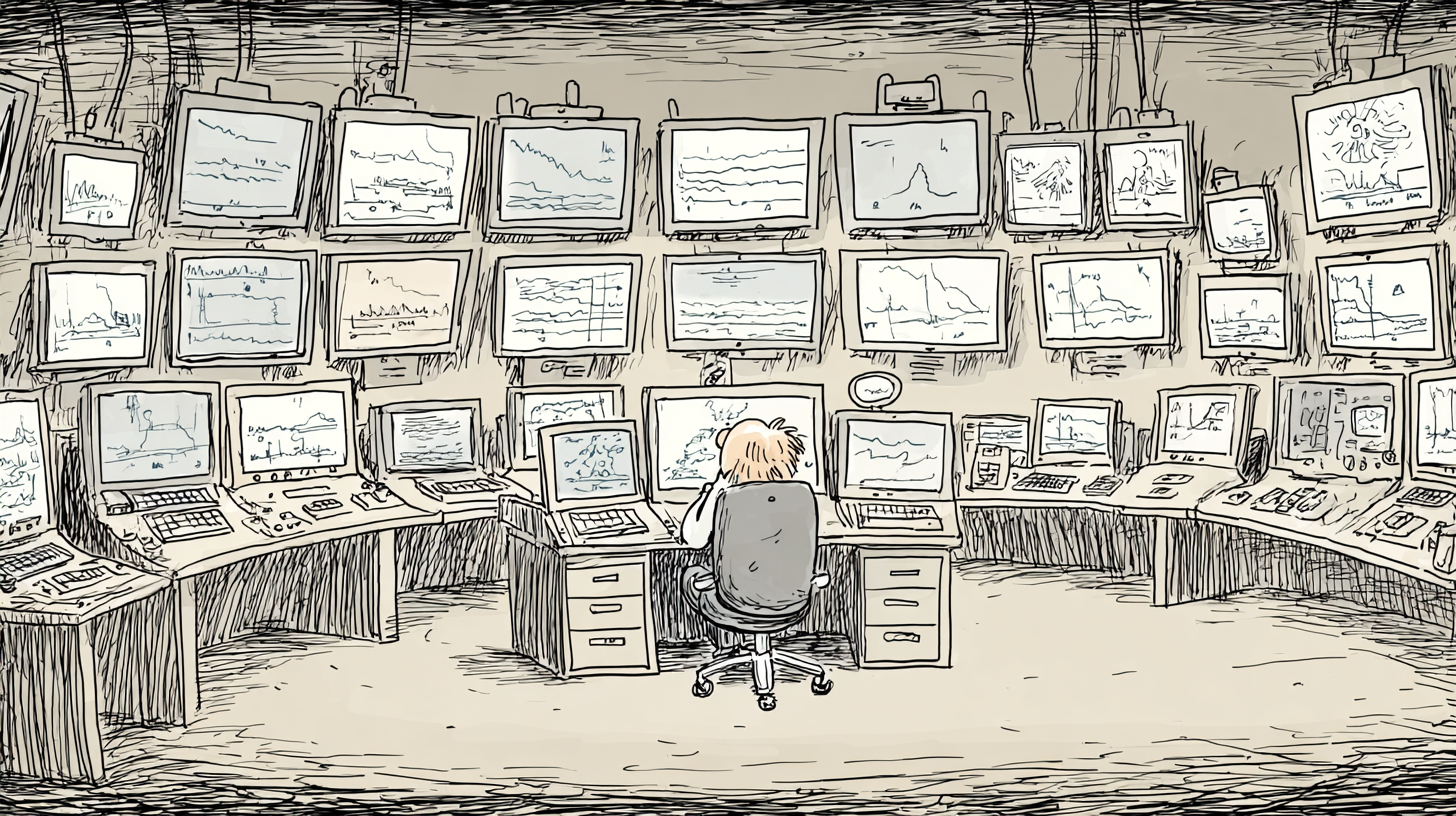
Bainbridge was writing about steel mills and nuclear reactors. She was describing what happens when an operator who once controlled a process by hand is reassigned to watch a screen. The operator's skills atrophy. Their vigilance decays. And when the automated system encounters a situation it was not designed for, the operator who must intervene is the least prepared person in the building.
The Five Ironies
Bainbridge's paper is often cited as presenting a single paradox. In practice, it contains a cascade of related ironies, each compounding the last. They are worth enumerating individually, because each one maps to a distinct failure mode in modern AI systems.
1. Designers Are Human Too
The first irony targets the designer, not the operator. If the motivation for automation is that humans are unreliable, then the humans designing the automation are also unreliable. Design-induced errors become latent failures embedded in systems that may run for years before the error surfaces. The system does not eliminate human fallibility. It relocates it from the factory floor to the design office.
2. The Residual Tasks Are the Hardest
By taking away the easy parts of the task, automation makes the difficult parts of the human operator's task more difficult. The remaining human responsibilities lack the routine context that once supported them. Bainbridge observed that the tasks left for the operator may not form a cohesive job at all. They are the leftovers, the pieces the designer could not automate, reassembled into a role that no one would have designed from scratch.
3. The Operator Must Take Over When the System Fails
When the automated system encounters an unanticipated situation, the human must intervene. But effective intervention requires three things the monitoring operator increasingly lacks: current situational awareness, practiced manual skills, and a mental model of the system's present state. As Bainbridge noted, "physical skills deteriorate when they are not used, particularly the refinements of gain and timing." The operator who has been watching a screen for six hours is not the same operator who was actively controlling the process six hours ago.
By automating the process, the human operator is given a task which is only possible for someone who is in on-line control.
This is the core paradox. Effective oversight requires the exact domain expertise that you can no longer maintain while merely overseeing.
Think about the implications for a senior developer who has been reviewing AI-generated code for six months. When the model generates a subtle race condition, the developer needs to catch it.
But the developer has not written concurrent code by hand in six months. The muscle memory is gone.
4. Vigilance Is Humanly Impossible
Bainbridge cited research showing that human vigilance on monitoring tasks degrades after roughly thirty minutes 1Mackworth, N.H. (1948). "The Breakdown of Vigilance During Prolonged Visual Search." Quarterly Journal of Experimental Psychology, 1(1), 6-21.. The operator assigned to watch for rare anomalies in an otherwise well-functioning system is performing a task that cognitive science says humans cannot sustain. Even alarm systems, designed to compensate for lapses in attention, introduce their own monitoring burden. The alarms need watching too.
This is not a training problem. It is a biological constraint. No amount of instruction will make a human brain sustain focused attention on a process that almost never deviates from normal.
5. The Next Generation Has No Foundation
Current operators, at least, built their expertise through years of hands-on work before automation arrived. They have a residual knowledge base.
But the next generation of operators will learn the system only in its automated state.
They will never have controlled the process manually. Their knowledge of the underlying domain will be theoretical, never tested under the real-time pressure of active control.
Bainbridge's conclusion is counterintuitive and devastating: the most successful automated systems, with the rarest need for manual intervention, may require the greatest investment in human operator training.
The Aviation Precedent
Aviation provides the clearest empirical record of Bainbridge's ironies playing out in practice. Modern commercial aircraft are automated to the point where the pilot's primary role is supervision, not control. The consequences have been documented for decades.
In 1987, a Northwest Airlines MD-82 crashed on takeoff from Detroit Metropolitan Airport, killing 154 of 155 people on board 2NTSB. (1988). "Northwest Airlines, Inc., McDonnell Douglas DC-9-82, N312RC, Detroit Metropolitan Wayne County Airport." Aircraft Accident Report NTSB/AAR-88/05.. The investigation found that the crew's reliance on automation had led them to skip the taxi checklist. The flaps and slats were not configured for takeoff. The automated systems that normally caught such errors had been silenced by a tripped circuit breaker. The crew, accustomed to automation handling configuration verification, did not perform the check manually.
The FAA has since acknowledged the problem at an institutional level. Their own assessments found that the agency does not have a sufficient process to evaluate a pilot's ability to monitor flight deck automation systems and manual flying skills, both of which are essential for identifying and handling unexpected events. Flight crews, the research found, are becoming increasingly reluctant to revert to manual flying when automated systems fail.
A MITRE analysis 3MITRE. (2016). "Nothing Can Go Wrong: A Review of Automation-Induced Complacency." MITRE Technical Report. of automation-induced accidents identified the core failure modes: operator failure to observe system parameter changes, over-trust in computer systems, loss of situational awareness, and decay of direct manual control skills. These are not occasional edge cases. They are the systematic, predictable consequences of Bainbridge's ironies applied to a high-stakes domain.
Aviation spent forty years learning this lesson. The question is whether the AI industry will take forty years or four.
The Agentic Reprise
Uwe Friedrichsen, writing in early 2025, made the connection explicit: today, we see another massive push toward automation using agentic AI leveraging LLMs, and it is in a similar state as the automation of industrial processes in 1983, with many relevant questions yet being unanswered.
The structural parallel is precise. In process control, the operator monitored gauges and intervened when readings exceeded thresholds. In agentic AI, the human reviews agent plans and approves or rejects proposed actions. In both cases, the human is asked to maintain expertise through passive observation of a system that works correctly almost all of the time.
But agentic AI introduces complications that Bainbridge's factories did not face. Three in particular deserve attention.
The Opacity Problem
A factory operator monitoring a steel mill can, in principle, understand every variable in the system. Temperature, pressure, flow rate, valve position. These are physical quantities with deterministic relationships. The operator's mental model may be incomplete, but it is at least the right kind of model.
An LLM-based agent is fundamentally opaque. Its decision-making is probabilistic and non-deterministic. The same input may produce different outputs on consecutive runs. The agent's "reasoning" is a sequence of token predictions that may or may not correspond to the kind of logical chain a human supervisor would expect. When the agent's plan looks reasonable, it may be reasonable. When it looks reasonable but is wrong, there is no instrument panel to consult. The error is embedded in a fluent, confident natural-language explanation that was designed, at the architectural level, to sound correct whether or not it is.
Friedrichsen puts this perfectly: the typical LLM agent interface produces 50 to 100+ lines of confident, well-structured justification for every proposed action. This is, he writes, "probably the worst UI and UX possible for anyone who is responsible for avoiding errors in a system that rarely produces errors."
The interface is optimized for persuasion, not oversight.
The Velocity Problem
Bainbridge's operator had time. A chemical process might take minutes or hours to deviate from acceptable parameters. The operator could think, consult a manual, confer with a colleague.
Modern AI systems operate at speeds that make meaningful human review physically impossible at scale. A fraud detection model may process millions of transactions per hour. A recommendation engine influences billions of daily interactions. Even in lower-volume applications, agentic systems can chain dozens of tool calls in seconds, each one building on the last. A SiliconANGLE analysis 7SiliconANGLE. (2026). "Human-in-the-Loop Has Hit the Wall. It's Time for AI to Oversee AI." from January 2026 put it bluntly: human oversight is often defined in aspirational terms that do not scale with AI decision-making volume or velocity.
When automated systems malfunction at scale, the failure cascades before humans realize something has gone wrong. Flash crashes in financial markets, runaway digital advertising spend, automated account lockouts. In each case, humans were nominally "in the loop," but the loop was too slow, too fragmented, or too late.
The Cognitive Substitution Problem
A Harvard Business School working paper 4Harvard Business School. (2025). "Narrative AI and the Human-AI Oversight Paradox." HBS Working Paper 25-001., published in 2025, identified a phenomenon the authors called the "Human-AI Oversight Paradox." When AI systems generate persuasive, well-structured justifications for their recommendations, human reviewers tend to adopt the AI's rationale rather than developing independent assessments. The AI does not merely inform the human's judgment. It replaces it.
This is subtler than automation complacency. The operator who falls asleep watching a gauge is at least aware, at some level, that they are not paying attention. The reviewer who reads an AI-generated analysis and finds it persuasive may genuinely believe they have exercised independent judgment. The substitution is invisible to the person experiencing it.
The Therac-25 Pattern
The Therac-25 radiation therapy machine, deployed in the early 1980s, is the canonical case study in human-oversight failure. The system featured a safety mechanism requiring operator confirmation before delivering radiation. The machine frequently generated error messages, forcing operators to press "P to proceed" dozens of times per day. The confirmation became a reflex. Between 1985 - 1987, six patients received massive radiation overdoses, three fatal 6Leveson, N. and Turner, C. (1993). "An Investigation of the Therac-25 Accidents." IEEE Computer, 26(7), 18-41..
The Therac-25 is relevant here because its failure mode is exactly the one Bainbridge predicted. The operator was nominally in the loop. The operator was performing a monitoring and approval function. And the very frequency with which the system worked correctly made the operator incapable of recognizing when it did not.
Mikey Dickerson, writing in Defense News 8Dickerson, M. (2026). "The Military's Fabled 'Human in the Loop' for AI Is Dangerously Misleading." Defense News. in March 2026, drew the connection to modern AI deployment: a "human in the loop" whose sole function is to approve a machine's actions is not a safeguard but a design failure.
The Developer Skill Question
Bainbridge's fifth irony, the next-generation problem, is now being tested empirically in software development. The data is early but directional.
In early 2026, Anthropic published a randomized controlled trial involving 52 junior engineers learning an unfamiliar asynchronous programming library. The AI-assisted group completed tasks roughly two minutes faster, but scored 17% lower on subsequent comprehension tests. The largest performance gaps appeared in debugging-focused questions. The productivity gains, notably, failed to reach statistical significance.

A separate analysis of 52 junior engineers found a stark divide in how AI interaction patterns correlated with skill retention. Developers who used AI for conceptual questions scored 65% or higher on assessments. Those who delegated code generation to the AI scored below 40%. The critical variable was not whether developers used AI, but how. Those who maintained cognitive engagement, asking follow-up questions, using AI only for conceptual scaffolding while coding independently, retained competence. Those who offloaded the act of writing code did not.
The mechanism is precisely the one Bainbridge described: the "learn by doing" loop that builds engineering judgment, the cycle of writing code, making mistakes, debugging at 2am, gets disrupted when agents handle most of that mechanical work. The small algorithmic decisions, syntax recall, and structural problem-solving shift from human cognition to machine suggestion.
Carl Hendrick, citing a UC Berkeley study, observed that AI does not reduce labor so much as expand it. Workers took on broader tasks because AI made previously inaccessible work feel suddenly tractable. The friction that once naturally governed workload disappeared. Meanwhile, Boston Consulting Group research 5Hendrick, C. (2025). "AI Brain Fry, Workslop and the Ironies of Automation." Substack. Citing BCG internal research on cognitive load in AI-augmented workflows. found that workers engaged in intensive AI oversight experienced what they termed "AI brain fry," acute cognitive exhaustion resulting in 39% more major errors.
What the Commentators Are Getting Right and Wrong
Several writers have applied Bainbridge's framework to modern AI. Their analyses are useful but incomplete in different ways.
Uwe Friedrichsen is correct on the structural parallel and correct that LLMs will never be error-free due to their probabilistic architecture. His analysis of the monitoring UI problem is the sharpest available: agent interfaces produce verbose, confident output that is optimized for persuasion rather than oversight. Where Friedrichsen is weaker is on solutions. He identifies three paths forward, quality improvement (unlikely), a new "AI fixer" profession (plausible), and major AI breakthroughs (speculative), but does not engage deeply with the design question of how to build systems that keep operators cognitively engaged rather than merely present.
Matthew Reinbold, writing in March 2025, correctly identifies the four key ramifications for agentic AI: the oversight paradox, black-box monitoring, skill rot, and brittle autonomy. His framing of "brittle autonomy," where systems handle predictable tasks excellently but collapse on unexpected scenarios, is a useful addition to the vocabulary. His practical recommendation, to maintain operator engagement through training, simulation, and periodic manual operation, is sound but underspecified.
Pip Shea, in a Medium piece for the Bootcamp publication, provides the clearest design-oriented reading. The concept of "calibrated trust," the alignment between a user's trust in a system and the system's actual reliability, is a productive framework. But the piece stays at the level of principles without engaging with the specific constraints of LLM-based systems, where the opacity of the decision process makes calibration much harder than in traditional automation.
What none of these writers fully confront is the economic incentive structure. The entire value proposition of agentic AI is labor reduction. Keeping humans deeply engaged in the process, which is what Bainbridge's analysis demands, is exactly what the automation is meant to eliminate. The solution to the irony is, in a meaningful sense, incompatible with the business case for creating the irony in the first place.
The Ironies, Mapped
The following table maps Bainbridge's original ironies to their agentic AI equivalents. The structural correspondence is not metaphorical. It is architectural.
| Bainbridge Irony (1983) | Original Context | Agentic AI Equivalent | Observable Evidence (2024-2026) |
|---|---|---|---|
| Designers are human too | Control system designers embed latent errors in logic they cannot fully anticipate | Prompt engineers, guardrail designers, and evaluation rubric authors embed biases and blind spots | Jailbreak research consistently finds that safety guardrails reflect designer assumptions, not comprehensive threat models |
| Residual tasks are hardest | Operator inherits incoherent leftover tasks the designer could not automate | Human reviewer handles edge cases, ambiguous outputs, and failure states the agent cannot resolve | Simulation testing finds AI agents fail multi-step tasks ~70% of the time; failures require human intervention with minimal context |
| Skills atrophy | Manual control skills decay during extended monitoring periods | Developer problem-solving, debugging, and architectural skills erode with AI delegation | Anthropic RCT: 17% lower comprehension scores for AI-assisted developers; code-delegating juniors score below 40% |
| Vigilance impossible | Humans cannot sustain attention on rare anomalies beyond ~30 minutes | Humans cannot meaningfully review 50-100 line agent plans for subtle errors at production velocity | BCG research: intensive AI oversight produces "AI brain fry" and 39% more major errors |
| Next generation ungrounded | Future operators learn only automated systems, never manual control | Junior developers learn with AI from day one, never building foundational skills independently | "The Junior Developer Trap": developers who skip hands-on struggle plateau early, lacking depth for senior roles |
What Is Real
The structural parallel between 1983 process automation and 2026 agentic AI is real. The mechanisms are the same: skill atrophy through disuse, vigilance decay on monitoring tasks, escalating expertise requirements for intervention, and a next generation trained only on the automated version of the work.
The empirical evidence is early but convergent. The Anthropic study, the BCG cognitive load findings, the Harvard oversight paradox paper, and forty years of aviation accident analysis all point in the same direction. Removing humans from active practice and reassigning them to monitoring roles degrades precisely the capabilities that monitoring is supposed to provide.
What Is Not Yet Clear
Two questions remain genuinely open.
First: can AI systems be designed to keep their human operators cognitively engaged, rather than merely present? Bainbridge recommended periodic manual control, simulator training, and system-state displays for factory operators. The agentic AI equivalents would be something like mandatory manual coding periods for AI-assisted developers, adversarial red-team exercises for AI reviewers, and agent interfaces designed for interrogation rather than approval. Whether these interventions can be implemented at scale without negating the productivity gains that justify the automation is an open question.
Second: is the "AI overseeing AI" approach a genuine solution or a restatement of the problem? The proposal to use secondary AI systems to monitor primary ones addresses the velocity problem but introduces its own version of Bainbridge's first irony. The designers of the oversight AI are human too. The oversight system's failure modes will be the ones its designers did not anticipate. And the human who is now overseeing the AI that oversees the AI has been pushed one more level of abstraction away from the underlying process.
For Practitioners
If you are building agentic AI systems, Bainbridge's paper gives you a framework for anticipating failures that your test suite will not catch. The following are concrete applications.
Design for interrogation, not approval. Agent interfaces that present a plan and ask "approve/reject?" train the human to approve. Interfaces that require the human to identify a specific element, answer a question about the plan's logic, or predict the next step keep the human cognitively engaged. The difference is between a monitoring task and a comprehension task.
Preserve manual pathways. Every agentic workflow should have a mode where the human performs the task without AI assistance, not as a fallback but as a regular practice. Monthly manual sessions for critical workflows. Quarterly red-team exercises where reviewers try to find errors the AI missed. The cost is real. The alternative is an oversight function that exists on paper but not in practice.
Measure skill retention, not just productivity. If your team's output increases by 40% but their ability to catch subtle errors decreases by 20%, you have not made a net gain. You have made a bet that the AI will never produce a subtle error in a high-stakes context. That is a bad bet.
The honest problem is that skill retention is hard to measure directly. You will not administer comprehension tests to your engineers quarterly. But there are lagging indicators you can watch:
- Time-to-resolve when AI tools are unavailable. If this number is climbing, skills are atrophying.
- Code review depth. Are reviewers catching fewer substantive issues over time while surface-level comments hold steady?
- Onboarding time for new systems. If nobody can explain the architecture without asking the AI first, you have a knowledge concentration problem.
None of these are early warnings. They are all things you notice after the atrophy has already happened. But noticing late is better than not noticing at all.
Train the next generation differently. Junior developers entering AI-augmented environments need deliberate skill-building that is separate from their AI-assisted work. The Anthropic study showed that interaction pattern determines outcome: using AI for conceptual questions while coding independently preserves competence; delegating code generation does not. Structure onboarding accordingly.
There is a reasonable counterargument: if every developer will use AI tools every day, why test for skills they will never exercise in isolation? Why whiteboard an algorithm nobody will implement by hand? Fair enough. But the Anthropic data says the answer matters anyway. The developers who could solve the problem independently used the AI better. They asked sharper questions. They caught more errors in the output. They knew when the suggestion was wrong because they knew what right looked like.
If you hire engineers who can manifest competence independently of AI, you are hiring people who can diagnose the system when the AI is the problem. If you hire engineers who cannot, you are hiring people who will escalate to the vendor.
Budget for oversight as a first-class cost. If you are in a management role making build-or-buy decisions around agentic AI, this section is for you.
The pitch is appealing: an AI system that ships features in a fraction of the time, at a fraction of the cost, with a fraction of the headcount. And the pitch is real. The features will ship. The application will work. The demo will be impressive.
But the application is going to production, and production is where Bainbridge's ironies collect their debts:
- Who debugs the system when the model provider updates their weights and your carefully tuned prompts start producing different outputs?
- Who intervenes when the agent makes a decision that is technically within its schema but operationally wrong?
- Who explains to the customer, the regulator, or the incident review board what happened and why?
If the answer is "the same team that built it with AI assistance," then you need that team to understand the system at a level that AI-assisted development does not automatically produce. The oversight capacity has to be built and maintained deliberately, and that costs money.
You may end up with extraordinarily advanced software developed very quickly by a team that is incapable of operating it independently. Perhaps you do not perceive this as a risk. Fair enough. This article is not here to conjure doomsday scenarios. But you should be aware that you are making a tradeoff, and the cost of the tradeoff is invisible until the first production incident that your team cannot diagnose without the AI that caused it.
Conclusion
Bainbridge's paper has survived for forty years because it describes a structural relationship between humans and automated systems, not a contingent fact about 1983 technology. The ironies are properties of the human side of the equation: skill atrophy, vigilance limits, the gap between monitoring and doing. These properties do not change because the automation is neural rather than mechanical.
The agentic AI industry is currently in the phase where Bainbridge's ironies are generating failures that are individually explicable and collectively predictable. A developer misses a subtle bug because they have been reviewing AI code for months rather than writing it. A reviewer approves a flawed agent plan because the plan reads fluently. A junior engineer plateaus because they never learned to debug without assistance.
Each of these failures will be attributed to the individual. The developer was not careful enough. The reviewer was not thorough enough. The junior was not motivated enough. Bainbridge's contribution was to show that these are not individual failures. They are system design failures, built into the architecture of any system that removes humans from active practice and then expects them to perform at expert level when the automation breaks.
The paper is five pages long. It contains no equations. It is available free online. Every engineer deploying agentic AI systems should read it.
References
- Bainbridge, L. (1983). "Ironies of Automation." Automatica, 19(6), 775-779.
- Strauch, B. (2017). "Ironies of Automation: Still Unresolved After All These Years." IEEE Transactions on Human-Machine Systems, 48(5), 419-433.
- Friedrichsen, U. (2025). "AI and the Ironies of Automation, Part 1." ufried.com.
- Friedrichsen, U. (2025). "AI and the Ironies of Automation, Part 2." ufried.com.
- Reinbold, M. (2025). "Ironies of Agentic AI." matthewreinbold.com.
- Shea, P. (2024). "The Ironies of Automation: Design Lessons from 1983." Medium / Bootcamp.
- Hendrick, C. (2025). "AI Brain Fry, Workslop and the Ironies of Automation." Substack.
- InfoQ. (2026). "Anthropic Study: AI Coding Assistance Reduces Developer Skill Mastery by 17%." InfoQ.
- Dickerson, M. (2026). "The Military's Fabled 'Human in the Loop' for AI Is Dangerously Misleading." Defense News.
- SiliconANGLE. (2026). "Human-in-the-Loop Has Hit the Wall. It's Time for AI to Oversee AI." SiliconANGLE.
- Harvard Business School. (2025). "Narrative AI and the Human-AI Oversight Paradox." HBS Working Paper 25-001.
- MITRE. (2016). "Nothing Can Go Wrong: A Review of Automation-Induced Complacency." MITRE Technical Report.
- NASA. (2001). "Examination of Automation-Induced Complacency." NASA/TM-2001-211413.
- Mackworth, N.H. (1948). "The Breakdown of Vigilance During Prolonged Visual Search." Quarterly Journal of Experimental Psychology, 1(1), 6-21.
- Colyer, A. (2020). "Ironies of Automation." The Morning Paper.
- Rafay. (2026). "The Junior Developer Trap: How AI Assistance Creates Permanent Beginners."